
In today’s busy world, people are looking for food that is healthy, quick to cook, and full of nutrition. Khichdi perfectly matches all these needs. It can be cooked in just 20–25 minutes, and it does not need expensive ingredients. This is why many health-conscious people and fitness lovers are also adding khichdi to their daily diet.
Khichdi is also helpful for weight management because it is light, low in oil, and high in fiber. It keeps the stomach full for a long time without adding extra calories. For children and old people, it is soft and easy to eat, so they can also enjoy it without any difficulty.
In recent years, different versions like quinoa khichdi, millet khichdi, and oats khichdi have also become popular. These new variations mix the traditional taste of khichdi with modern healthy grains. This shows how khichdi has not lost its importance even today. It has simply changed with time, but the heart of the dish remains the same – simple, healthy, and comforting.
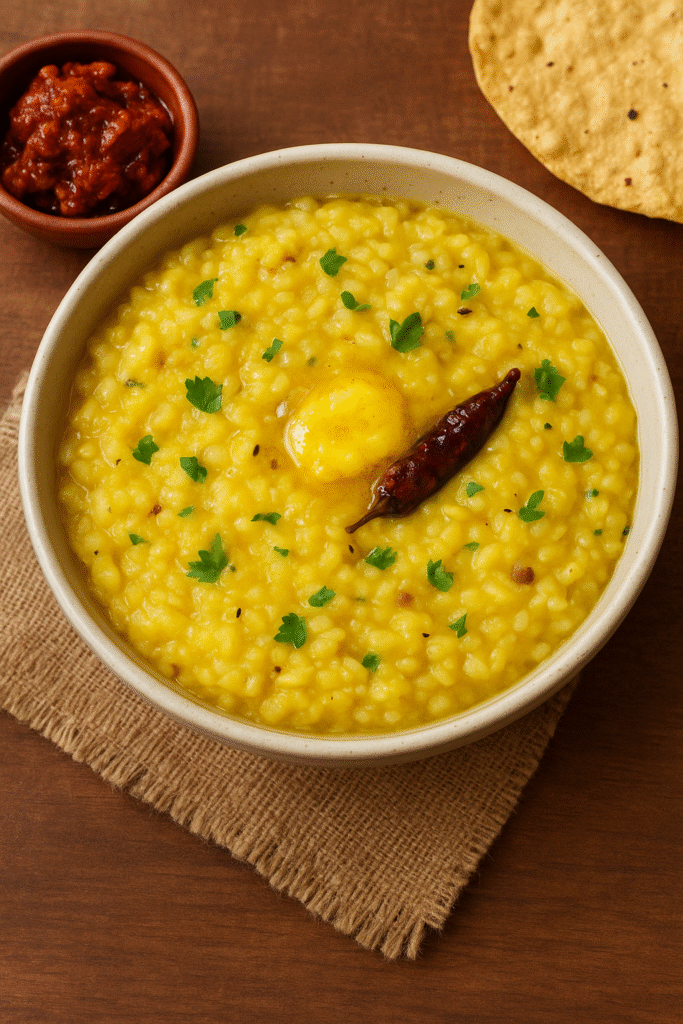
When we talk about Indian food, many names come to our mind like roti, dal, rice, curry, and sweets. But one dish which is very simple, very healthy, and loved by almost every Indian family is Khichdi. Khichdi is made with rice and lentils. It is light, soft, and very easy to digest. For some people, khichdi is a food for sick days, but for many, it is also a comfort food that they love to eat with ghee, papad, or curd.
Even though khichdi looks very simple, it has a very big place in health, culture, and religion of India. Let us understand this dish in detail.
1. Health Benefits of Khichdi
One of the biggest reasons khichdi is famous is because it is very healthy. Doctors often recommend khichdi to people who are sick, weak, or suffering from stomach problems. Let us see why:
- Easy to digest: Rice and lentils both become soft when cooked together, so the stomach can digest them very easily.
- Complete protein: Rice alone does not give full protein and dal (lentils) alone also does not give full protein. But when we mix rice and lentils, the body gets complete protein.
- Balance of nutrients: Rice and lentils together give carbohydrates, protein, and fiber. If ghee is added, it gives good fat also.
- Light food: When a person has fever, weakness, or stomach upset, heavy food is not good. At that time, khichdi is the perfect choice because it gives energy without troubling the stomach.
- Pure food: Khichdi is also counted as “satvik” food in Ayurveda, which means it keeps the body clean, light, and full of energy without disturbing the mind.
So, khichdi is not just food, but a complete meal that is healthy, balanced, and suitable for everyone from children to old people.
2. Cultural Importance of Khichdi
Khichdi is not only healthy but also has a deep cultural value in India. It is often called the “comfort food” of India. Whenever people feel tired or sad, eating hot khichdi with ghee, papad, and curd gives a feeling of happiness and relaxation.
- Food for fasting: Many people also make khichdi during fasts and religious days. It is light and suitable as a fasting meal.
- Family food: Khichdi is one dish which everyone in the family can sit together and eat. It does not need too many ingredients, but it brings everyone together.
- Simplicity: Even with only rice, lentils, and salt, khichdi can be made tasty and filling. This shows the simplicity and humble nature of Indian cooking.
That is why khichdi is loved as a food that connects health, comfort, and culture.
3. Religious Significance of Khichdi
Khichdi also has a very strong religious value in Indian society.
- In many temples and religious gatherings, khichdi is served as prasad to devotees.
- During the Makar Sankranti festival, khichdi is made in many parts of India as a special dish. In Uttar Pradesh and Bihar, this day is even called “Khichdi Day”.
- In Gujarat, pigeon pea lentil khichdi is very famous and often prepared in temples and homes.
- Because khichdi is a pure vegetarian and satvik dish, it is considered sacred and good for religious offerings.
So, khichdi is not only food, but also a part of India’s religious traditions.
4. Recipe of Simple Khichdi
Now let us see how khichdi is made at home. It is one of the easiest dishes to cook and does not take much time.
Ingredients:
- Rice – 1 cup
- Moong dal – 1 cup
- Water – 3–4 cups
- Ghee/Oil – 2 tbsp
- Cumin seeds – 1 tsp
- Asafoetida (hing) – 1 pinch
- Ginger – 1 tsp, grated
- Green chili – 1 chopped
- Turmeric powder – 1 tsp
- Salt – to taste
Method:
- Wash rice and lentils properly and soak them in water for 15–20 minutes. This makes cooking faster and the grains softer.
- Heat ghee in a pressure cooker. Add cumin seeds, a pinch of asafoetida, and green chili. Let them crackle.
- Add grated ginger and stir for a few seconds.
- Add the soaked rice and lentils. Mix properly.
- Add turmeric powder, salt, and 3–4 cups of water.
- Close the cooker lid and cook for 3–4 whistles.
- When steam is released, open the cooker and mix the khichdi well.
- Serve hot with a spoon of ghee, papad, pickle, or curd.
Hot khichdi served with curd, papad, and ghee is one of the simplest yet tastiest meals in India.
5. Different Types of Khichdi in India
Khichdi is not made in only one way. Different states of India have their own special style of making it.
- Gujarati Khichdi: Made with rice and pigeon pea lentils (tuvar dal), often served with kadhi and papad.
- Bengali Khichuri: A richer version with vegetables and spices, enjoyed during festivals.
- South Indian Pongal: A similar dish made with rice, lentils, ghee, and black pepper, especially popular in Tamil Nadu.
- Masala Khichdi in North India: Spicy version with vegetables like peas, carrots, and beans.
Even though the recipes are different, the heart of khichdi remains the same – simple, healthy, and comforting.
Conclusion
Khichdi is more than just food. It is health, culture, religion, and comfort in one bowl. From being recommended by doctors for sick people, to being served in temples as prasad, to being enjoyed by families together at dinner – khichdi is truly a dish of India.
Its simplicity, nutrition, and cultural value make it not only a meal but also a symbol of Indian tradition. Whether it is a sick day or a festival day, a bowl of hot khichdi always brings comfort, energy, and happiness.
Hi, this is a comment.
To get started with moderating, editing, and deleting comments, please visit the Comments screen in the dashboard.
Commenter avatars come from Gravatar.